We install spray foam and injection foam insulation across Greater Binghamton and Broome County. Attics, existing wall cavities, crawl spaces and rim joists, and pole barns and metal buildings.
Every job starts with a free assessment at your property and a written, itemized price that names the exact product and attaches its data sheet. The quick answers most people want first:
- Cost. Depends entirely on treated surface area, which is not the same as your house’s square footage. Attics typically run $3,000 to $8,000, crawl spaces $2,000 to $4,000, rim joists around $2,000 to $2,500, existing walls $4,000 to $10,000. Full detail below.
- Time. Most residential jobs are one or two days. Pole barns and full-house work run longer.
- Do you need to leave the house? During application and for a period afterwards, yes. EPA guidance is that occupants vacate during spray foam installation. We tell you the product we are using and give you its data sheet so the interval you get is the manufacturer’s, not a number we made up.
- Is the assessment free? Yes, at your property, with thermal imaging where it helps.
Where We Install Foam Insulation in Greater Binghamton
Attic Spray Foam
Leaky ceiling plane with warm air reaching the roof deck → foam air barrier at the correct plane → ice damming stops forming, upstairs rooms warm up.Attic spray foam insulation.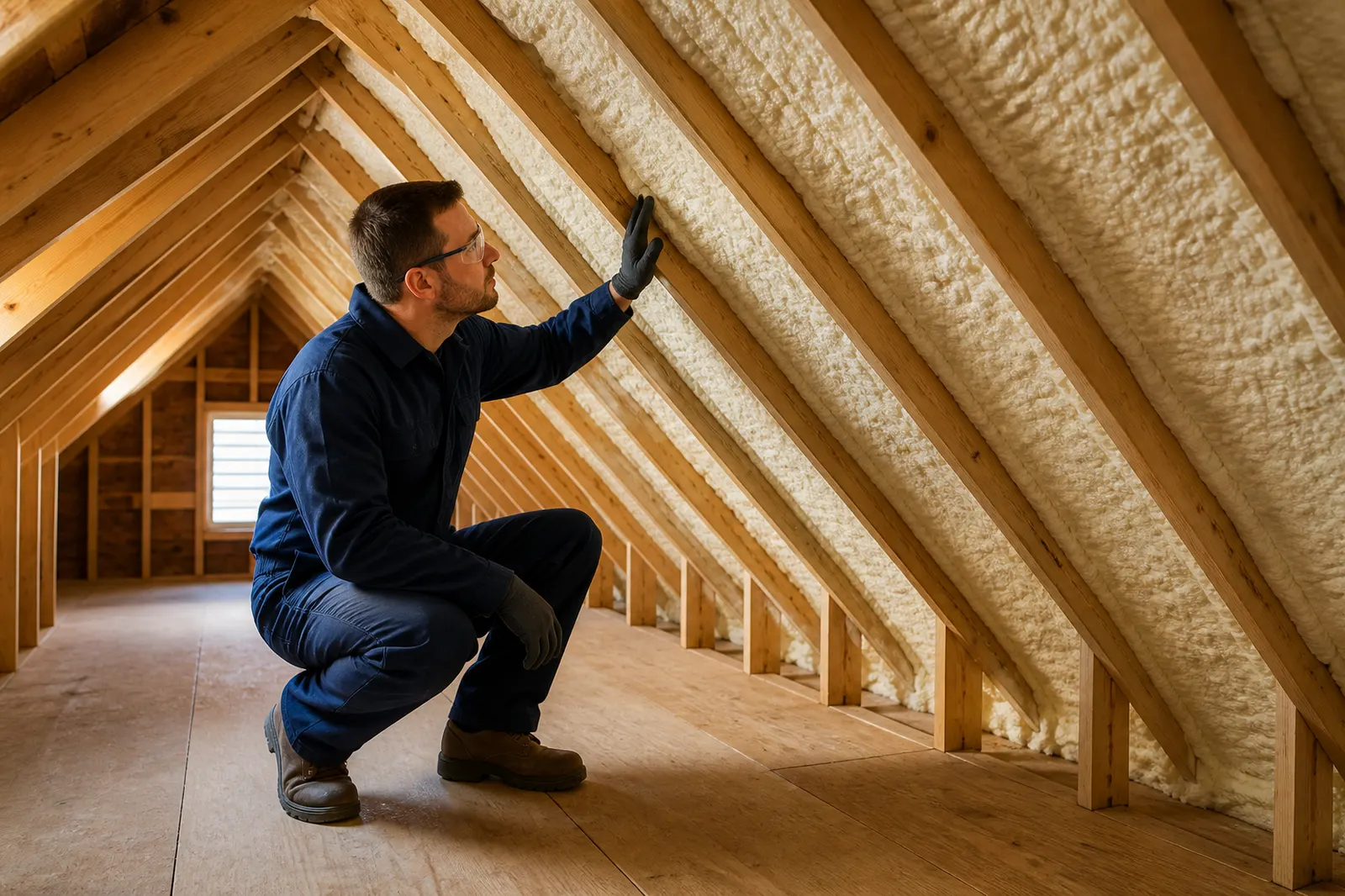
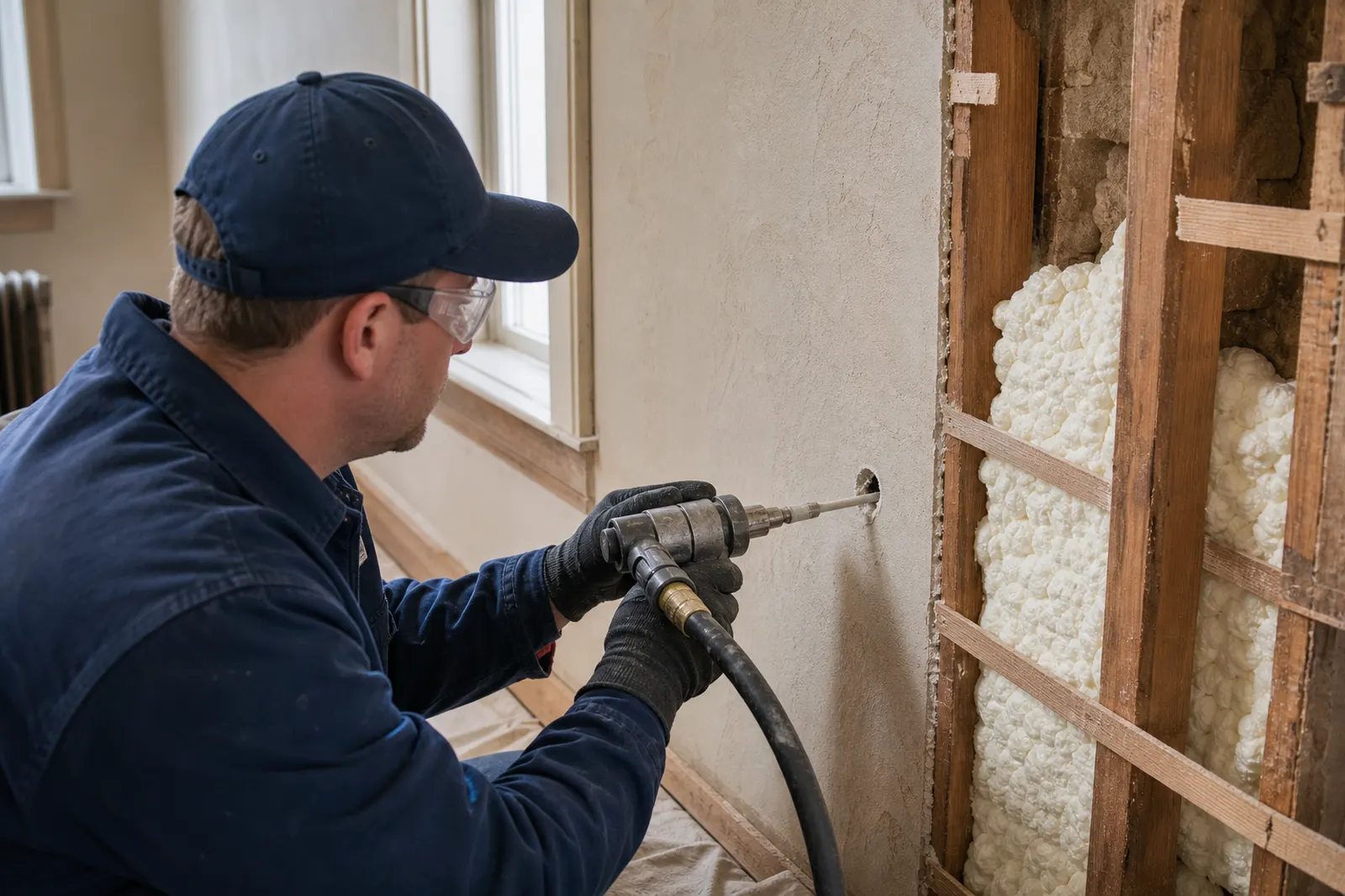
Injection Foam for Existing Walls
Empty wall cavity in a house built before insulation was standard → polyurethane injected through small access holes → insulated walls with no demolition and no re-siding.Injection foam wall insulation.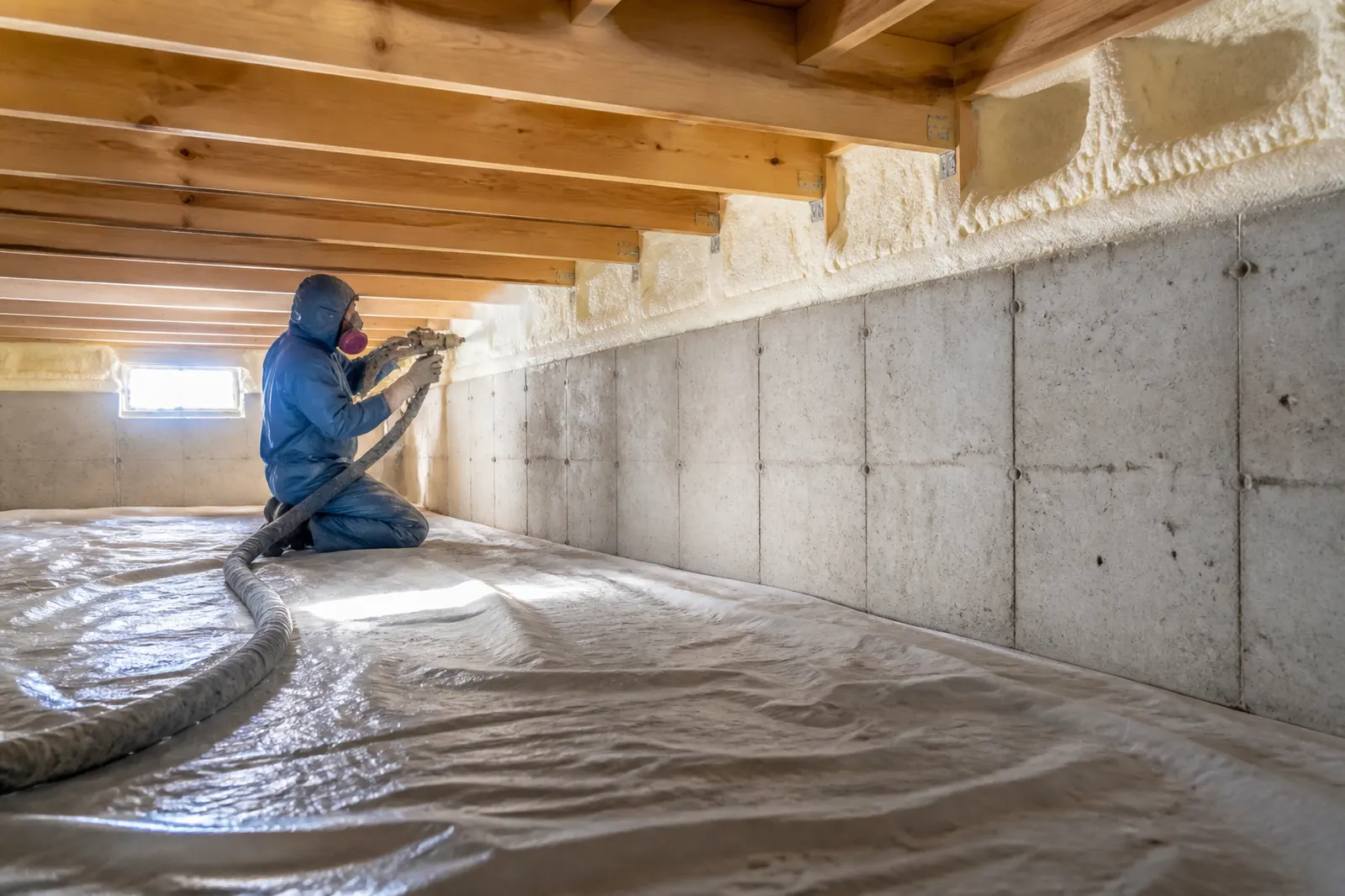
Basement, Crawl Space and Rim Joist Spray Foam
Cold foundation walls and open rim joist bays → closed-cell foam applied directly → insulation and air barrier in one application, below the first floor.Basement, crawl space and rim joist spray foam.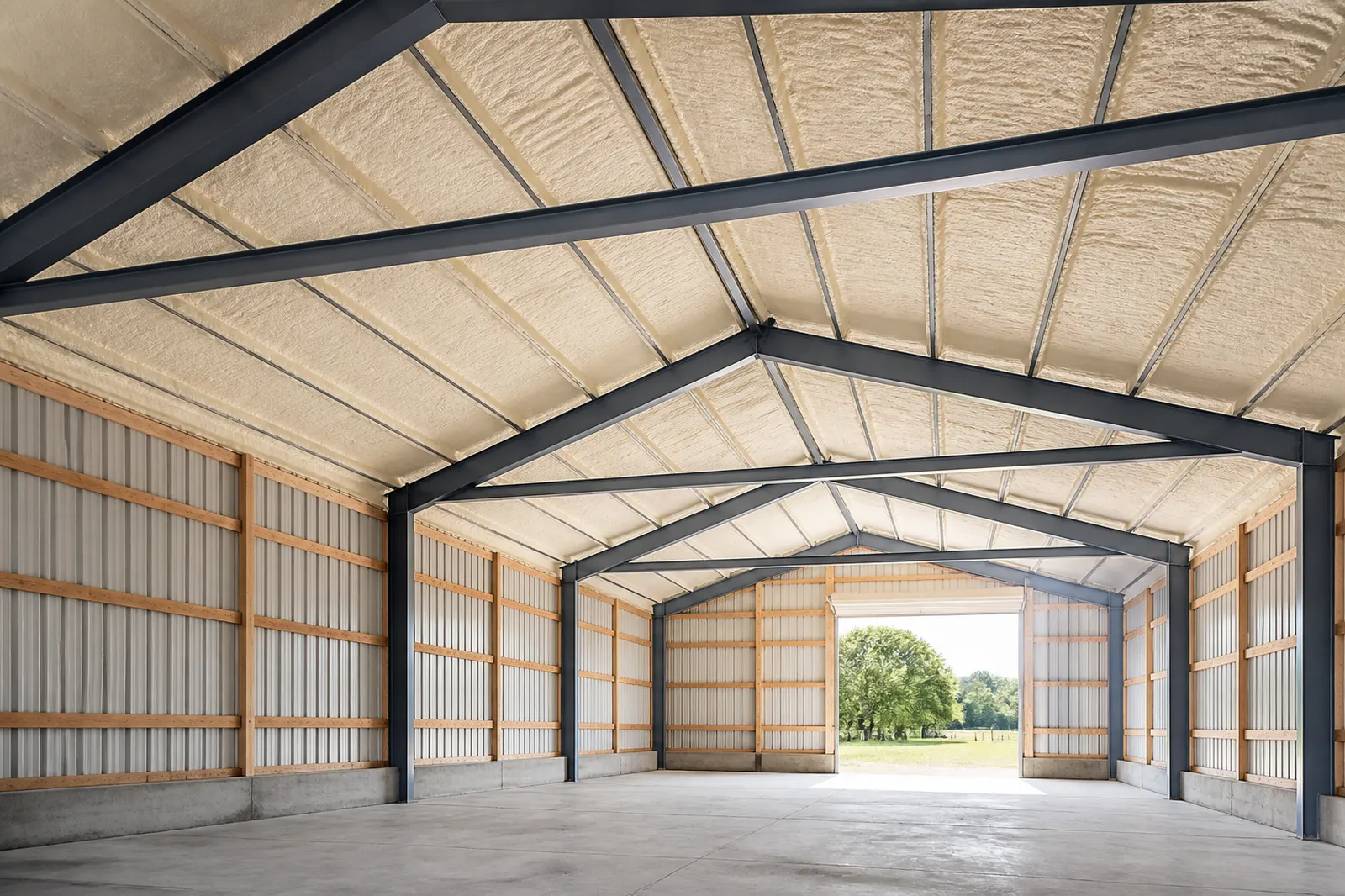
Pole Barn and Metal Building Spray Foam
Warm interior air meeting a cold steel skin → closed-cell foam bonded directly to the deck → the condensation drip that ruins your stored equipment stops, permanently.Pole barn and metal building spray foam.Get a Foam Insulation Quote for Your Binghamton Property
Free property assessment
Get Your Free Foam Insulation Quote
- Free assessment at your property
- Written scope and itemized price
- The product data sheet, attached
- Callback within one business day
What happens next: callback within one business day. Free assessment at your property, with thermal imaging where it helps identify what is actually happening. Written scope and itemized price, including the specific product and its data sheet, before you decide anything.
Straight Answers About Spray Foam Risks
Some concerns about spray foam are legitimate. Every one of them traces back to a decision made on the job rather than to the material, which is why we answer them in writing before any work starts.
Will Spray Foam Make My House Harder to Sell?
Not automatically, but foam at a roof deck hides the sheathing and framing behind it, so a buyer’s inspector will want records. We give you the product data sheet, the written scope, substrate moisture readings, and photographs of every bay before and after it is sprayed. Our guide to selling a house with spray foam covers what buyers and inspectors look for.
Why Do Some People Have Spray Foam Removed?
A short list of installation failures accounts for almost all of it: moisture at the roof deck, foaming over wet wood, off-ratio application, the wrong plane or assembly, and work that cannot be inspected afterwards. Removal is expensive and unpleasant, so who installs it matters. Read why spray foam insulation gets removed for each failure and how it is avoided.
Four Questions to Ask Any Foam Installer
- Which product, and can I see the technical data sheet? It gives the R-value per inch, the re-entry time, and the application temperature range.
- Will you measure the substrate moisture content before you spray? Wood above 18% moisture content should not be foamed over.
- Open-cell or closed-cell at the roof deck, and if open-cell, what is the vapor retarder? Broome County is in climate zone 6, where open-cell at a roofline needs a separate Class II vapor retarder.
- Will you photograph every bay before you spray? Once foam is on, that framing is invisible permanently.
Two more warning signs: a quote that is one number with no itemization, and pressure to sign at the kitchen table. New York gives you three business days to cancel any home improvement contract.
What Foam Insulation Costs in Binghamton
Installed cost ranges vary by assembly and treated surface area.
| Material | Installed $/sq ft | R per inch |
|---|---|---|
| Open-cell spray foam | $1.50 – $3.50 | 3.5 – 3.7 |
| Closed-cell spray foam | $3.00 – $5.00 | 5.0 – 7.0 |
| Application | Typical range |
|---|---|
| Attic | $3,000 – $8,000 |
| Exterior walls | $4,000 – $10,000 |
| Crawl space | $2,000 – $4,000 |
| Rim joists | $2,000 – $2,500 |
| 2,000 sq ft of treated surface | $3,000 – $10,000 |
Why two quotes for the same house differ by thousands
Because spray foam is priced on treated surface area, and “my house is 2,000 square feet” is floor area. Those are different numbers and they are not proportional.
A 2,000 square foot house might have 1,200 square feet of attic floor plane, or 2,600 square feet of roofline if the foam goes at the deck instead. Two contractors quoting “the attic” can be quoting two entirely different areas, and neither of them is wrong, they are proposing different assemblies.
The first question to ask any quote: what surface area is this based on, and which plane are you spraying?
The rest of the drivers
- Depth specified. Foam is sold by the board foot. Three inches costs 50% more than two, and the required depth is a code and assembly question rather than a preference.
- Open cell versus closed cell. Roughly double the material rate for closed-cell, and it is the assembly that decides, not the budget.
- Access and staging. The rig has to reach the space. Hose length is finite.
- Masking and containment. More in an occupied house than an empty one.
- Removal of existing material. Old fiberglass or cellulose coming out first is a separate line.
- Number of setups. Two disconnected areas in one visit costs more than one continuous area.
- Whether the building is occupied, which affects containment, scheduling, and sometimes whether the job can happen at all in one pass.
Full itemized cost breakdown, including a worked 2,000 square foot example.
State incentives
NYSERDA’s Comfort Home program currently pays $2,500 for an air sealing plus attic and rim joist package, and $3,000 for one adding wall and floor insulation. EmPower+ covers income-qualified households at up to $12,000 per project upstate, or 50% up to $6,000 for moderate-income households.
Both require a NYSERDA participating contractor, so it depends on who you hire. Amounts change. Comfort Home · EmPower+
Closed-Cell and Open-Cell Spray Foam
Both are polyurethane. The difference is whether the individual cells are sealed.
Closed-Cell Spray Foam: Where It Belongs
R-5 to R-7 per inch. Rigid once cured. Low vapor permeability, so it is generally its own vapor control. Adds racking strength to a wall. Costs roughly double per square foot.
It belongs: at a roof deck in this climate, on foundation and crawl space walls, in rim joist bays, on the underside of steel roofing in a pole barn, and anywhere the assembly needs vapor control as well as insulation.
Open-Cell Spray Foam: Where It Belongs
R-3.5 to R-3.7 per inch. Soft and vapor-permeable, which means moisture can pass through it, which is sometimes what you want because it lets an assembly dry. Cheaper per square foot and expands far more per unit of material.
It belongs: in interior partitions for sound, in wall cavities in the right assembly, and at a roof deck only where a separate Class II vapor retarder is part of the specification, because in climate zone 6 the code requires one.
The honest summary: open-cell is not the cheap version of closed-cell. It is a different material with a different job. Anyone who tells you open-cell is fine everywhere because it is cheaper has not thought about your assembly, and anyone who tells you closed-cell is always better is selling you the more expensive product. Our closed-cell vs open-cell spray foam comparison goes through each application.
R-Value Per Inch
The ranges above (5.0 to 7.0 closed-cell, 3.5 to 3.7 open-cell) are typical figures across the category, and the spread on closed-cell is 40%. The number for your job comes from the technical data sheet of the specific product being sprayed. We publish the data sheet for every job we do. Nobody else in this market does.
Does Foam Need a Vapor Barrier?
Closed-cell, at adequate thickness, generally is one. Adding a separate vapor barrier over it usually creates a sandwich that cannot dry in either direction, which is worse than either layer alone.
Open-cell at a roof deck in Broome County does need one. That is the code position for climate zones 5 through 8 and it is not optional.
Anywhere else, the answer depends on the assembly, and “we always do it this way” is the wrong answer regardless of which way it is.
How Our Foam Insulation Process Works
Assessment, at your property, free.
We look at the assembly, not just the space. Thermal imaging where it helps identify what is actually happening. Moisture readings on any wood we would be spraying against. For an attic, we work out which plane is right for your roof before we quote either one.
Written scope and itemized price.
Including the specific product name and its technical data sheet, the depth, the treated surface area, the containment plan, and the re-entry interval that product requires.
Product and depth selected per assembly.
Not per price point. If closed-cell is the right answer we will say why, and if open-cell is fine we will say that too and charge you less.
Masking and containment.
Everything not being sprayed gets covered. Ventilation set up. Occupants and pets out for the interval on the data sheet.
Application, photo-documented bay by bay.
Before and after. This is not a formality. Once foam is on, that framing is invisible forever, and these photographs are the only record that will ever exist of what was behind it.
Post-cure verification and thermal imaging.
We come back and image the work. On an injection foam job this is the only way to prove the cavities filled completely. You get the images.
Serving Greater Binghamton and Broome County
Johnson City
Endicott-Johnson-era worker housing with empty wall cavities as the norm. Injection foam is the lead service here.Vestal
Suburban stock with crawl spaces and walk-outs, plus the university rental corridor where landlord retrofits cluster.Endicott
Factory-era stock where floodplain proximity means moisture gets sequenced before foam.Endwell
Mid-century ranches with vented crawl spaces and more detached garages and outbuildings than the villages.We also work in Conklin, Chenango Bridge, Apalachin, Port Dickinson, Hillcrest, Chenango Forks, Union Center, West Corners, and Kirkwood. Pole barn and metal building work extends further, across Broome and into Tioga County.
Why Choose Us for Foam Insulation
We Publish the Product Data Sheet for Every Job
The manufacturer, the product, and the sheet, in your written scope before you agree to anything. That sheet contains the R-value per inch, the re-entry interval, and the application conditions. It is the single most useful document in a foam job and almost nobody hands it over.
We do this because in a trade where the material’s reputation depends entirely on installation quality, the data sheet is the only thing that turns a claim into a checkable fact.
Written Scope and Itemized Price Before Any Work Starts
Treated surface area, depth, product, containment, exclusions, price. New York law requires any home improvement contract over $500 to be in writing with specified terms, and you have three business days to cancel. We volunteer that rather than waiting for you to find out.
Thermal Imaging Verification After Install
We image the work after it cures and you get the images. On injection foam it is the only way to confirm a complete cavity fill, and any contractor who does not offer it cannot demonstrate the job was done.
Photographs of Every Bay Before We Spray
The record of what was behind the foam. Yours, not ours.
What Happens After You Call
Callback within one business day. Free assessment at your property. Written scope with the data sheet attached. No pressure and no kitchen-table close.
Frequently Asked Questions About Foam Insulation in Binghamton
Will spray foam make my house harder to sell?
Not automatically, but roof-deck foam can prompt questions because an inspector cannot see the sheathing and framing behind it. Keep the product data sheet, written scope, moisture readings, and before-and-after photographs so the installation can be evaluated from evidence rather than guesswork.
Why do some people have spray foam removed?
Almost always because of an installation failure rather than the material. The documented causes are moisture reaching cold roof sheathing through vapor-permeable foam, insufficient thickness putting the foam’s inner surface below the dew point, application over wood already above 18% moisture content, and off-ratio mixing that produces foam which cures badly and smells. Each of those is a decision made on the job.
The one that is not a failure but is still real: foam permanently obscures the structure it covers, so nobody can inspect that framing again.
Is spray foam cheaper than fiberglass or cellulose in the long run?
Not per square foot, and not usually on a simple payback calculation either. Foam costs several times what fiberglass or cellulose costs to install.
What foam does that the others do not is air sealing, in the same application. In a heating-dominated climate like this one, air leakage rather than R-value is often the dominant heat loss path, and that is where the value sits. If your house is leaky, foam addresses something batts cannot. If your house is already reasonably tight and you just want more R-value in an attic, cellulose is cheaper and perfectly good, and we will tell you so.
Does spray foam need a vapor barrier?
Closed-cell at adequate thickness generally is one, and adding a separate barrier over it usually creates an assembly that cannot dry in either direction.
Open-cell at a roof deck in Broome County does need one. Broome is in climate zone 6, and the residential code requires air-impermeable insulation at a roof deck in zones 5 through 8 to be a Class II vapor retarder or carry a Class II coating.
Do you handle older homes with knob-and-tube wiring?
We handle the houses; we do not bury live knob-and-tube. Knob-and-tube wiring depends on open air around the conductors to dissipate heat, and packing insulation around live circuits is a documented fire concern.
If we find live knob-and-tube in a cavity we are meant to fill, that is a stop condition. The circuit gets cleared or replaced by an electrician first, and then we fill the wall. This comes up regularly in pre-1950 Binghamton and Johnson City stock, so if your house is that age it is worth finding out before you get attached to a schedule.
Are there rebates in New York?
Yes, through NYSERDA. Comfort Home currently pays $2,500 for an air sealing plus attic and rim joist package and $3,000 for one adding wall and floor insulation. EmPower+ covers income-qualified households at up to $12,000 per project upstate or 50% up to $6,000 for moderate-income households. Both require a NYSERDA participating contractor.
Amounts change, so check the live NYSERDA pages rather than trusting a number on any contractor’s site.
How long do I need to stay out after installation?
Long enough for the product to cure and the space to be ventilated and cleaned, and the specific number comes from the product’s data sheet rather than from us. EPA guidance is that occupants and other workers vacate during installation; for professional two-component systems, some manufacturers recommend around 24 hours, though it varies by product. We name the product in the written scope and attach its sheet, so you get the manufacturer’s interval.
If anyone in your household has asthma or other respiratory sensitivity, raise it at the assessment. EPA specifically advises discussing vulnerable occupants with the contractor in advance.
What happens after I request a quote?
Callback within one business day. Free assessment at your property with thermal imaging where it helps. Written scope and itemized price, including the product name and its technical data sheet. Nothing signed on the day.
Get a Free Foam Insulation Quote
Free property assessment
Get Your Free Foam Insulation Quote
- Free assessment at your property
- Written scope and itemized price
- The product data sheet, attached
- Callback within one business day
Free assessment. Written scope with the product data sheet attached. Photographs of every bay before we spray.
If you are still working out whether foam is the right answer at all, that is a reasonable place to be, and the assessment is the part where we find out together.